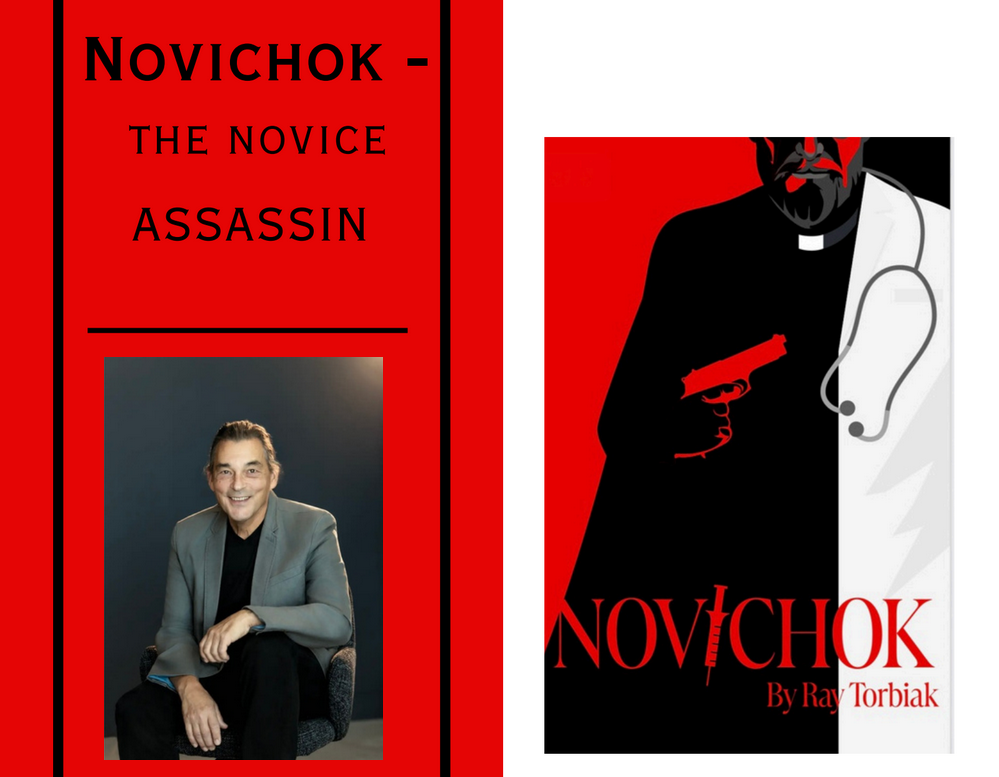
We don’t often picture the author of the next best-selling spy thriller to be a local Burlington doctor. But that’s exactly Dr. Ray Torbiak, debut author of Novichok: The Novice Assassin and local radiologist in our very own Joseph Brant Hospital. The book follows Joe, a Canadian surgeon with a painkiller dependence and a dementia diagnosis that draws him into vigilantism and a mission to save millions of people. Novichok isn’t your typical spy novel; rather, it is a mosaic of years of COVID-19 pandemic struggles, Ukrainian heritage, and a lifetime of hard work in medicine.
The journey
After a grueling few years of the COVID-19 pandemic, Dr. Torbiak began thinking about writing to do something with his mind beyond the demands of his job.
“We all got overworked,” he recalls. “And it was extremely difficult. I found it stressful.”
Dr. Torbiak’s wife Roxanne saw his struggle and introduced him to writing via a narrative-based medicine course offered at the University of Toronto. The concept of narrative-based medicine was developed by Dr. Rita Charon, a New York physician with a doctorate in English literature, to help doctors get closer to their patients and understand them as “human beings rather than a liver.” Taking this course required rigorous reading, writing, and analysis of other people’s work, which sparked something in Dr. Torbiak. What began as an exercise for reflection evolved into a passion for storytelling — and eventually the creation of this novel.
The process of writing, however, was not as simple as it seemed on the surface.
“I would wake up at three or four in the morning with an idea,” he says. “I’d go downstairs, and I’m not a good typist. I type with two fingers from each hand. It was murder to type this thing.” It took Dr. Torbiak more than a year to write the first draft. Then, he underwent three rounds of editing over two years with a screenwriter and editor based in London, U.K. The editing phase was a key period of learning for Dr. Torbiak in becoming an author. He explains the intensive process: he would get assignments from his editor, rewriting sections multiple times. In the end, he threw away nearly half of the original draft. Ultimately, though, it led to learning how to make a story more interesting and believable for readers.
More on Novichok: dementia and the contrasting healer and assassin
Drawing on his own experience as a physician whose work is underpinned by the Hippocratic Oath, “Do no harm,” Dr. Torbiak’s novel presents the protagonist’s journey through an ambiguous moral conflict. It blurs the line between morality and survival, putting a healer in the seemingly impossible position of a killer. After Joe, the hero of Novichok, is diagnosed with dementia, he has to become a killer in order to get a cure for his condition. Dr. Torbiak said he chose dementia specifically because of some personal family history and his clinical experience with his own patients, all of whom he has watched gradually fade at the hands of this disease. The slow, inevitable loss of identity made dementia thematically significant, while the fictional miracle cure provided motivation for the protagonist to take extreme risks.
Dr. Torbiak’s takeaways from Novichok
While Novichok’s dedication page honours the people of Ukraine and their defenders, Dr. Torbiak also extends the message to oppressed people everywhere. He said, “The world is in such a mess, you know, and we need to look for the things we can do, not to inspire violence, but to inspire peace.”
After reading his book, Dr. Torbiak hopes that readers will see themselves in the story, reflect on the state of the world, and feel empathy for those living under oppression. He would like to spread his sense of responsibility, emphasizing that even small acts of compassion and understanding can ripple outward.
“It’s a big world — we ought to share the world better than we do.”
A message to healthcare professionals
Dr. Torbiak is also a strong advocate for the narrative medicine course that he took, describing some of its activities as so impactful that he continues to do them today. One assignment he recalls was to set a timer for ten minutes, and just write with a pencil on paper about real experiences, whether an argument with a spouse or colleague, a difficult conversation with a patient, or witnessing a patient’s decline.
Beyond using the ten-minute method to prompt reflections, Dr. Torbiak highlighted the importance of being observant.
“When you go outside, just take a walk. Notice things more. And then write down how you feel about what you notice,” he suggests.
Developing this habit, he explained, not only helps to nurture mindfulness and reflection, but it may even go further and lead to writing more extensively — and maybe even a whole book.
As Dr. Torbiak says, “A little bit of hard work, some motivation, interest, and a passion in a subject can accomplish great things.”
Looking ahead, Dr. Torbiak acknowledges finding time to write is challenging, especially amid Ontario’s severe radiologist shortage, as well as having two teenage daughters and a dog. Despite this, he hopes to continue his writing career. He also hinted at potentially developing two stories related to Novichok that explore some of the other characters in depth. Interested in keeping up with Dr. Torbiak’s journey and work? You can visit his website, novichok2025.com/the-book, which also lists where you can buy a copy of Novichok, and find him on Instagram, @ray_torbiak. Dr. Torbiak also has an upcoming book signing event in Mississauga, on Sun., Nov. 30, from 12 p.m. to 5 p.m. at Indigo Erin Mills.