By Emily R. Zarevich, Local Journalism Initiative Reporter
I push up my mask over my light brown hair to show my creamy skin, my secretive smile.
“And you can take that look off your face,” Anne says, throwing back her own hood, raising her head for me to raise her veil and free her of her mask.
“What look?”
“Your false face – your two-faced face. What are you thinking?”
A courtier’s mouth is always full of unspoken words. “I was thinking, it’s going to be hard to dance in this,” I lie. “It’s going to be hard to see.”
“We’re here to be seen, not to see.”
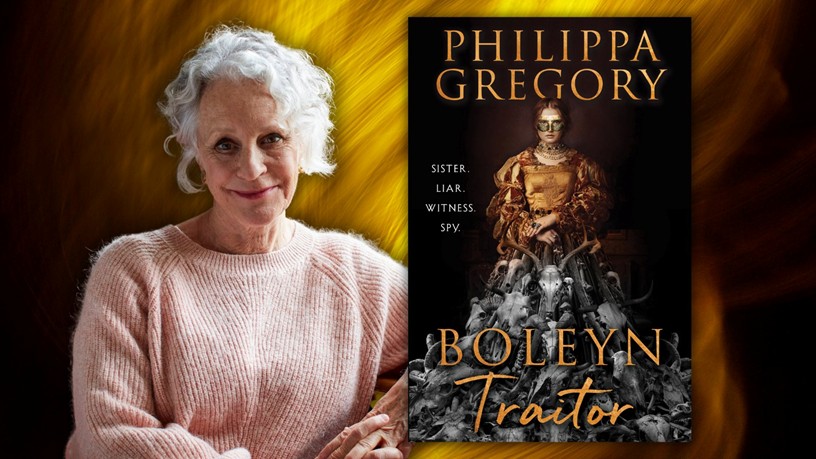
— An excerpt from British author Philippa Gregory’s new novel, The Boleyn Traitor.
On Wednesday, October 29, 2025, the Burlington Public Library was proud to welcome globally renowned historical fiction author Philippa Gregory as part of its fall 2025 speaker series via its digital resource, the Library Speakers Consortium. With Brandon Adler as host and event moderator, Gregory held court and made herself available to the eager questions of her enthralled readership from 2:00 p.m. to 3:00 p.m. by webinar. Her talk, appropriately titled “Courtly Intrigue and Whispers as Weapons,” was devoted solely to answering inquiries about her latest addition to her historical romance list, The Boleyn Traitor, which was published on October 7, 2025, by HarperCollins.
Gregory has been bringing the Tudor court to life on the page for decades. In 2001, she published The Other Boleyn Girl, her wildly popular novel that chronicles the life of Mary Boleyn, mistress to King Henry VIII and sister to Anne Boleyn, who would become Henry’s second wife. The book was critically acclaimed for its imaginative portrayal of the fierce rivalry for attention at the English court between the two famous Boleyn sisters. Now, twenty-four years and a string of Tudor novels later, Gregory is shifting the spotlight onto a third and much-ignored Boleyn woman: Mary and Anne’s sister-in-law, Jane.
When Jane Parker marries George Boleyn in 1524, she doesn’t realize that she will be quickly assimilated into what would become England’s most politically dominant family. Her sister-in-law, Anne Boleyn, uses her wits, beauty, and sex appeal to seduce her way to the throne. Through Anne’s long, tumultuous courtship with King Henry VIII and eventual marriage, Jane is thrust into the extraordinarily dangerous centre of high-stakes intrigue. In a way, she thrives. An opportunist, she glides naturally into the dual roles of spy and co-conspirator for great men such as Thomas Howard, Duke of Norfolk, and Thomas Cromwell. In another way, she flounders, finding herself in an increasingly vulnerable position as a woman in a sixteenth-century noble family whose power and influence ebbs and flows. She is, at the heart of things, a survivalist.
“She couldn’t be closer to the great stories of the Tudor court, and the women of the Tudor court,” Gregory said of her chosen subject. “She serves every single one of Henry’s queens, except the last, and that is because he has, by then, killed her. It’s a very dark story.”
Jane survives the scandal that sees the execution of her husband and sister-in-law/queen Anne Boleyn. She goes on to serve Henry’s future spouses, Jane Seymour, Anne of Cleves, and Catherine Howard. This character’s real-life participation in both Anne Boleyn and Catherine Howard’s downfalls makes her somewhat of a controversial figure in history, with historians vying to decide whether or not she is a scheming harlot, an unfortunate victim of bloodied politics, or something in between and much more complicated. In The Boleyn Traitor, Gregory colours in the blank spaces of Jane’s sparsely documented life through her usual narrative style of a first-person account.
“I think Jane is a really prime example of women who are described not according to their actions, but according to their observers,” Gregory remarked. “Jane’s really interesting because the first description we have of her from contemporary Tudor chroniclers is very, very slight, and very, very light. Just a mention of her here and there, as a lady of the court, as a woman taking part in a masque or a woman dressed in a particular colour on the day the chronicler is describing.”
“They don’t say, at the time, that she has anything to do with the trial of her husband or her sister-in-law. They don’t say that she gives any evidence,” Gregory continued. “When you get a later retelling of the story, particularly by the Victorians, they link the charge of her being involved in Catherine Howard’s adultery with the charge of Anne Boleyn’s adultery. They’ve got no evidence for that, but there’s just this assumption that she’s a woman who would do that sort of thing.”
By focusing on women subjects in her own Tudor series — queens, princesses, noblewomen, and even at one point a female court jester with psychic abilities — Gregory explores the gender dynamics that prevailed in the sixteenth century that simultaneously kept women in line and squirming in their chains. In The Other Boleyn Girl, Mary Boleyn grabs at a chance of realizing rare independence after a lifetime of being silently obedient to her controlling family’s ambitions. In this first installment of the Tudor series, Jane Parker had only a minor role, hovering on the outskirts of Anne and Mary’s story, and came across as only George’s bad-tempered, sex-crazed, and easily manipulated wife. Gregory hopes that The Boleyn Traitor rectifies this narrow characterization, fleshes Jane out more, and does her full story justice. She, too, was one of Henry VIII’s many victims.
“I think what Jane would want us to know is that whether a man is a domestic tyrant, in that he is a danger to everyone that he says he loves, or whether he’s a political tyrant, in that he is a danger to his country, both forms of tyranny are often the same,” Gregory said close to the end of the webinar, after being asked about what readers will take away from The Boleyn Traitor. “They often occur in the same man. They have to be confronted the minute you understand them. If you leave it too late, it’s too late. Jane understands that Henry VIII is a killer of his wives, his friends, and just people who he disagrees with. That’s someone who should be confronted the first time he raises his hand against a woman.”
Next up in the Burlington Public Library’s online speakers series is a Q&A with author Joseph Lee titled “Community, Power, and the Search for Indigenous Identity.” Interested parties can register for the event, which will take place on November 5, 2025, at 2:00 p.m., here. November 2, 2025, will also mark the beginning of Burlington’s annual BurlLITFest, or Burlington Literary Festival. The first event will be “In Conversation with Iona Whishaw,” the author of the Lane Winslow mystery series, on Sunday, November 2, 2025, at the Central location’s third floor from 1:00 p.m. to 2:00 p.m.