By Sydney Alexandra, Local Journalism Initiative Reporter
What began as one man’s healing journey in Winnipeg has now blossomed into a national movement of love, art, and mental health awareness, and this year, it’s finding a new home in Halton.
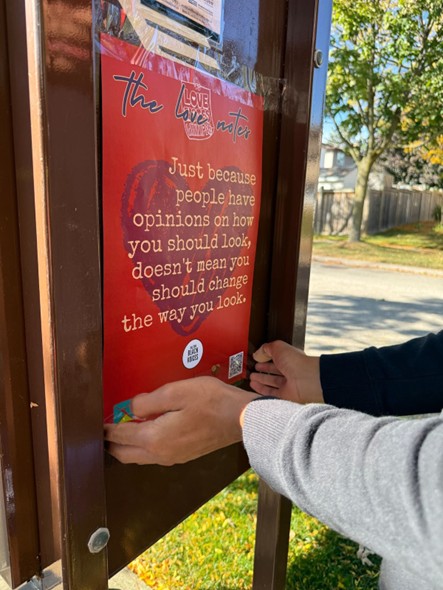
Through a collaboration between Halton Black Voices and poet and mental health advocate Ralph Bryant, the Love Notes Campaign has arrived in Ontario, transforming public spaces into canvases of compassion. Each “Love Note” is a handwritten affirmation posted in communities that offers a message of hope, vulnerability, and connection.
Bryant, the founder of Love Notes Winnipeg, describes the project as “a structure for healing,” one that invites people to pause, reflect, and feel seen. “It’s fun, it’s creative, but it’s also about saving lives,” he says.
Bryant’s path to poetry began long before Love Notes. Born in Harlem and raised in the Bronx, he started writing at just 8 years old. He shared that poetry was a way to process complex emotions in a childhood marked by instability and the absence of his father.
“I was always someone who felt a lot and was afraid to say what I was feeling in words,” Bryant recalls. “Writing became my escape. My local library was my sanctuary; a place to go when the lights were off or when I needed to be somewhere else.”
Growing up in a family with a history of mental illness, Bryant’s mother was diagnosed with paranoid schizophrenia at 16: “I have a family that has a legacy of mental illness, which I was aware of as a very young person.” He understood from an early age the importance of mental health.
Bryant’s love of literature led him to the works of James Baldwin and Nikki Giovanni, who transformed his view of what “Blackness” means to him:
“James Baldwin remains my biggest inspiration and influence and speaks to me both as a writer and also as someone attempting to reconcile his place in the world as a Black man, as a queer Black man, and while also attempting to reconcile religion and Blackness in the context of whiteness,” shared Bryant. “On the other side, Nikki Giovanni was also a big influence on me because she was the first poet who allowed me to see Blacknesses both tender and powerful.”
In Bryant’s later adolescence, he found inspiration from the new Black renaissance in film and the neo-soul movements. “When I graduated high school, I wanted to be Spike Lee. So that movement was certainly a part of my later influences.”
After the loss of a loved one and then a house fire eight years ago, Bryant faced one of the darkest periods of his life.
“I wanted to — I do — my own healing work, but more importantly build a structure in which I could be there to support my young sons, so that they would not have to experience what I had experienced and could be better prepared to recognize their own mental health challenges…and I could develop a language that would then help them develop their own language about what it meant to be a Black man. I want them to have the language and the capacity to ask for help; I want them to know they can be vulnerable and still be powerful.”
Bryant continued, “Black men’s mental health is important to me because I have two young (not so young!) Black sons, whose inherent nature of their existence will be perpetually seen as a threat in many ways.”
Bryant also points to systemic barriers that persist in North America’s mental health systems: “Psychiatry was built through a colonized lens. The institutions weren’t designed for us; for Black people, for Indigenous people, for women. Even today, access remains a major issue.”
Statistics from the CDC state that in 2023, suicide was the third leading cause of death for Black or African Americans aged 15 to 34. “We have a crisis. Not only of mental health, but of institutions that fail to see us as whole,” Bryant says.
“I didn’t actually have the money to seek therapy, and I didn’t have health insurance,” he explains.
Bryant began speaking into a microphone as a form of therapy, recording hundreds of hours of personal reflections. “I wrote two books of poetry about words and feelings that I was trying to create a release valve for that wasn’t about writing and creating the best poetry. It was because I had some things on my mind, and I needed to say and I needed to release them, energetically, so that I could move forward. That remains to be the case.”
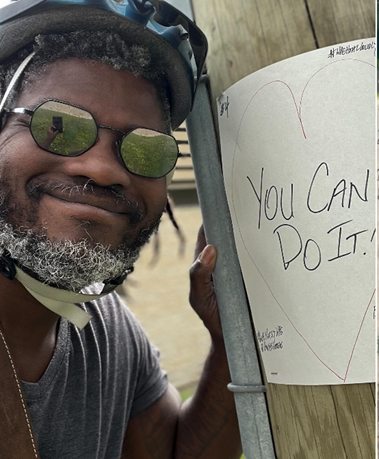
Those raw expressions eventually transformed into his first Love Notes: handwritten affirmations left around Winnipeg to uplift others who might be struggling.
“I started ripping pages from my sketchbook and biking around the city, putting them up wherever I went,” he says. “People began to respond; they’d email me or ask for more. I realized this could be something bigger.”
The partnership with Halton Black Voices marks a meaningful homecoming for Bryant, who lived in Burlington for 12 years and raised his children here.
“When I first moved to Burlington in 2008, I was worried about whether my kids would feel safe,” he reflects.
“Now, knowing that Halton Black Voices exists; that they’ve built a space for Black youth and families, it means everything to see Love Notes come to that community.”
Through this collaboration, Love Notes now appear in public spaces across Halton, sparking conversations around mental health and belonging.
“I hope people are inspired by the messages,” says Bryant. “I hope Halton makes their own Love Notes next year and passes them on to another community. I want it to start a chain reaction of kindness and creativity.”
Since its beginnings, Love Notes Winnipeg has grown from a one-person initiative to a coalition of over 100 volunteers, partnering with more than 20 community organizations, including Art City and the Canadian Mental Health Association Manitoba.
Bryant believes deeply in the power of art to heal. “Poetry saved my life. Writing gave me the ability to survive and to make a living doing what I love,” he explains.
He sees art as both a mirror and a light: “Especially in times like these, creativity can help us imagine another version of what life could be.”
Bryant envisions Love Notes expanding globally; a “franchise of wellness” built around what he calls “the five A’s”: affirmations, advocacy, alignment, action, and amplification.
“We start with affirmations, those messages of hope,” he explains. “Then we move toward advocacy and alignment, connecting art, community, and wellness. From there, it’s about action and amplifying our message: healing loudly together.”
Bryant wanted to share a message to anyone, especially men, who are struggling with their mental health: “I hear you, I see you, and I understand that you live in a world where it’s very easy to feel as if you are not worthy and you don’t belong. There will come a time, I hope, for you and for my sons and for your sons when that will not be the case, but the world we are in today means that we have to seek and find help with each other in brotherhood, in solidarity, and that you create a safety plan of humans that will be able to hold space for you until you can hold space for yourself and seek the help and support that feels right to you and until there is lots of help.”
Bryant encourages everyone to take part: learn more on the Halton Black Voices website, by following @lovenotesmb on Instagram, or by taking photos of Love Notes in the community and sharing the images on social media.
“Even the smallest act of love can shift a life,” Bryant says. “I hope people are inspired to think about the impact they can make and then go do it. It’s easy to feel like change isn’t possible, but I’m here to say that it is.”