By Maisha Hasan, Local Journalism Initiative Reporter
Earlier this fall, the Art Gallery of Burlington (AGB) showcased its new exhibit, “Gikinoo’amaatowin — This Is All Learning,” exploring Anishinaabe knowledge and practices through two artists: Jean Marshall and Nicole Richmond.
The name of this exhibit, “This is All Learning,” was inspired by Marshall’s reflection on her own work. The exhibition and its curation are fully produced by Anishinaabe women, with curator Albany Sutherland hailing from Thunder Bay, Ontario.
“[Jean and Nicole] are both from two distinct, separate communities, and they’re both very renowned and talented beadworkers and artists, especially in how their learning took place. Seeing each community’s beadwork style and passing these traditions down and then showing future generations as well is going to be important,” Sutherland said.
Choosing their work was relatively easy for Sutherland.
“These are both artists that I had relationships with previously and was familiar with their work before even coming to work for the AGB. They’re really active in my home community, and I think all of that, as a whole, has influenced my decision to choose them, their work, and to invite them to be part of this exhibition,” Sutherland explained.
This is Sutherland’s first exhibition with AGB, and her first time curating a show in beadwork — and hopefully, not the last.
“I’m excited to work with more Indigenous artists. AGB has a really strong background in craft because of the artist guilds that we have here, and because of our large ceramics collection. I think that’s something I’m looking to explore and utilize when I’m planning future shows at the gallery,” she said.
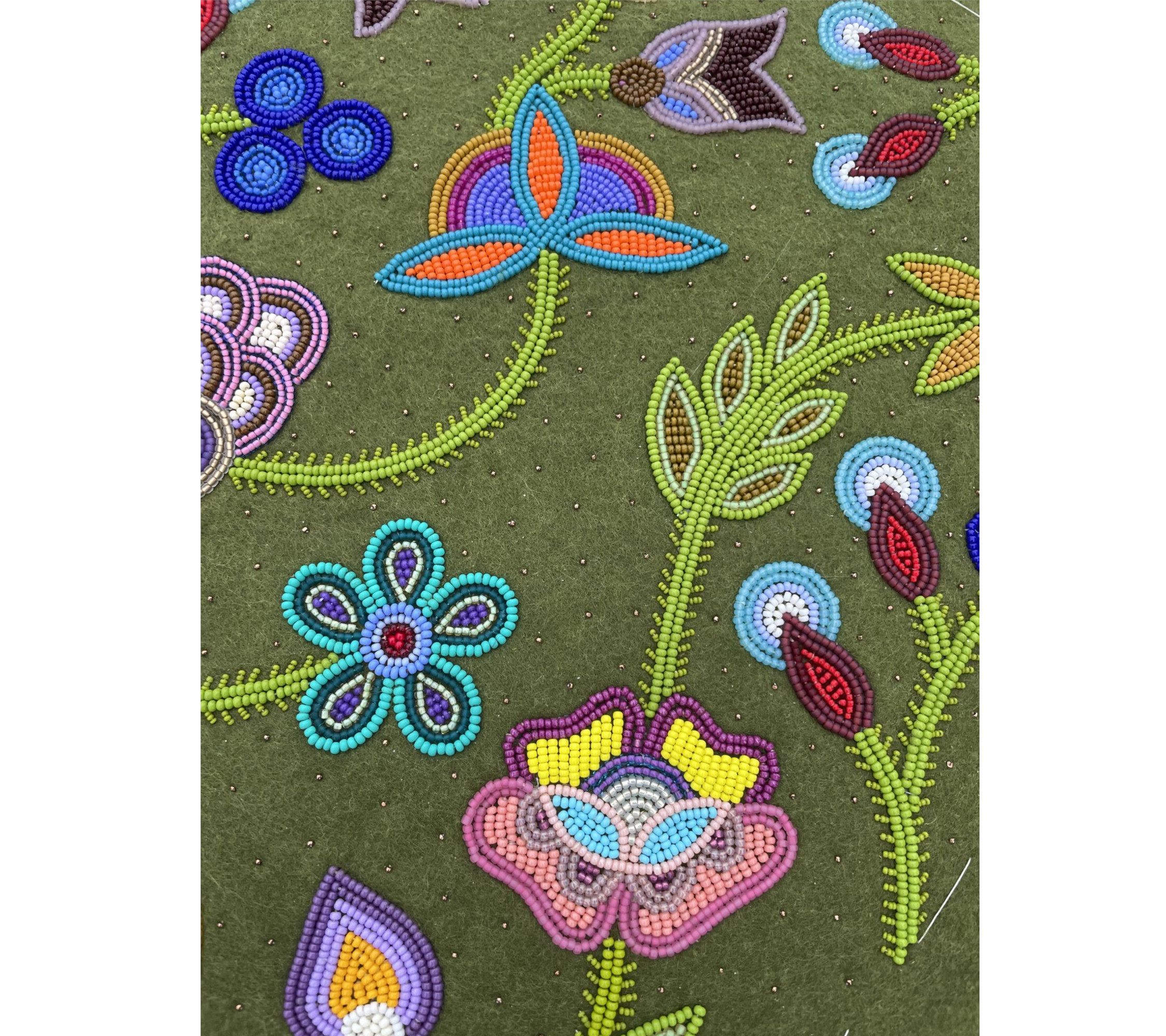
The exhibition focuses on Marshall’s beadwork, drawn from Anishnaabeg traditional art forms.
“I think beadwork has always been comforting to be around, even when I didn’t know how to do beadwork. I have always been drawn to the colours and designs of beading. Seeing the calibre of creativity in other makers has always been a source of inspiration and has helped me to try to do my best in the work that I do,” Marshall said.
Alongside her beadwork, Marshall has been learning hide tanning, the process by which animal skins are turned into leather through careful knowledge and practice. The animal skin that Marshall is working with in particular is moose, a huge feat in itself.
“Many people honour the moose by using the moose in its entirety; everything is used…it is a connection for me as an urban Indigenous person. Working with traditionally tanned moosehide as a canvas is a real treat for hands that sew. If it is well done, you don’t even need a thimble. It is the ultimate feeling to sew onto a moosehide that you made. There are no words. Just feels really good with a sense of excitement, pride, and accomplishment,” she said.
All parts of the moose are sacred. The nose, heart, and tongue are given to elders, the antlers and bones are used for making equipment and jewelry, and tendons are used for thread.
Aside from her own self-teaching, Marshall draws inspiration from co-artist Richmond.
“Nicole is a visionary. I have admired her work in the community for years. She is a giver and is a lead in demonstrating kindness and reciprocity. Her creativity is an added level of the gifts that she carries with her. In bearing witness to her work as a fellow artist, I have learned from Nicole that hard work takes perseverance and constant practice. Miigwech to Nicole for just being your deadly self and always lifting the community into the light,” she said.
Richmond, a lawyer and wellness consultant whose artistic practice includes beading and sewing, expressed similar sentiments about Marshall.
“Magical Jean is one of the wisest souls. She’s very idiosyncratic, meaning she is just doing her own thing and she is so sure of who she is, of what she wants to do, of what she believes in. I think she really role-models strength for me,” Richmond said.
She continued describing Marshall’s strengths, “She has a lot of spiritual gifts…she just knows things. She’s very decisive about her beliefs, and I admire her strengths so much. Obviously, she’s an excellent artist; her work is so beautiful.”
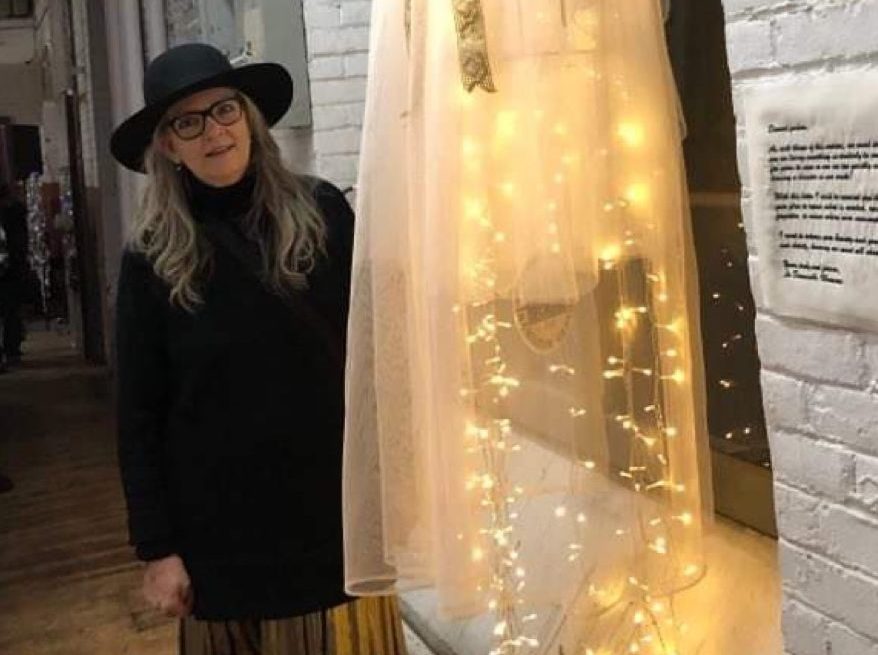
Richmond’s work in jingle dresses, a sacred Anishinaabe dress whose name comes from jingling metal cones sewn onto each dress, comes from a history of healing. It was given to the Anishinaabeg people through a dream via a father whose daughter was very sick. Despite trying all types of medicines and methods, only when wearing a jingle dress — made out of snuff cans at the time — was the daughter healed.
“I just had this idea of women wearing these rainbow dresses, [dancing] in different combinations; the women would have different dance moves based on different colours, like say red, blue, yellow, and green. That’s an important colour combination for Anishinaabe people. I just thought it would be so magical to make the dresses very similar to one another, but just slightly different. Eventually these dresses will go on the powwow trail and they will be danced in different communities,” Richmond described.
Healing resonates deep and true for Richmond, who went through a transformative loss in 2019. Experiencing significant grief shaped what healing meant for her.
“I could not even breathe. I could not walk. I could not do anything. I had to just sit and lay on the earth and just feel all of the feelings, and part of waking up from that had to be reconnecting with my own energy systems, values, and who I am. A lot of women across Ontario did a ceremony for me, prayed for me, and made offerings. I started to translate that healing practice and how I personally stepped back into my strength to a kind of relational or community understanding of what it looks like to be healthy. You can’t just become a healing expert without having had your own healing journey, and powwow dancing is really important for that,” she said.
Richmond credits a lot of her growth to the women in her Thunder Bay community as well as to the healing work she did herself.
“I had so much help. It was almost like I needed to access some energy,” she said of drawing from the people around her in her path to healing.
Richmond continued, “I’ve never actually really talked publicly about this. It was horrifying to go through that. And then to build yourself back up and [realize], ‘I can do this,’ because these deeply traumatic events are so transformative.”
In terms of what her next piece may look like, Richmond strives to continue tapping into Thunder Bay’s community of women.
“The First Nation women of Thunder Bay are role modelling how to arrive at our power as First Nations women. We’re really doing something up there. I know who to call on. I know who to ask for help. I know who’s doing what because we’re all assuming our responsibilities according to our own strengths and gifts. I think Thunder Bay is really interesting for role modelling how First Nations people are going to move forward. The women especially are doing it, and Jean is definitely a part of that, and I love it so much,” Richmond said.
The exhibit is running until January 25, 2026, in the Perry Gallery of the AGB. For more information, click here to visit the AGB’s website.