By Jack Brittle, Local Journalism Initiative Reporter
On October 6, the City of Burlington held their monthly Committee of the Whole meeting to discuss various items relevant to the city and its residents.
Item 8.2 on the meeting’s agenda was set to be a recap of the 2025 Sound of Music (SOM) festival and a discussion of its future direction. The meeting began with a number of delegations by individuals associated with the annual festival.
The Committee of the Whole was set to vote on a motion that would decline the Sound of Music Festival 2026 funding request and “discontinue municipal financial support due to ongoing financial instability and non-compliance with agreements and conditions.”
The motion would also “approve the reallocation of $150,000 — originally designated for Sound of Music in the 2026 Operating Budget — to the Community Investment Fund.”
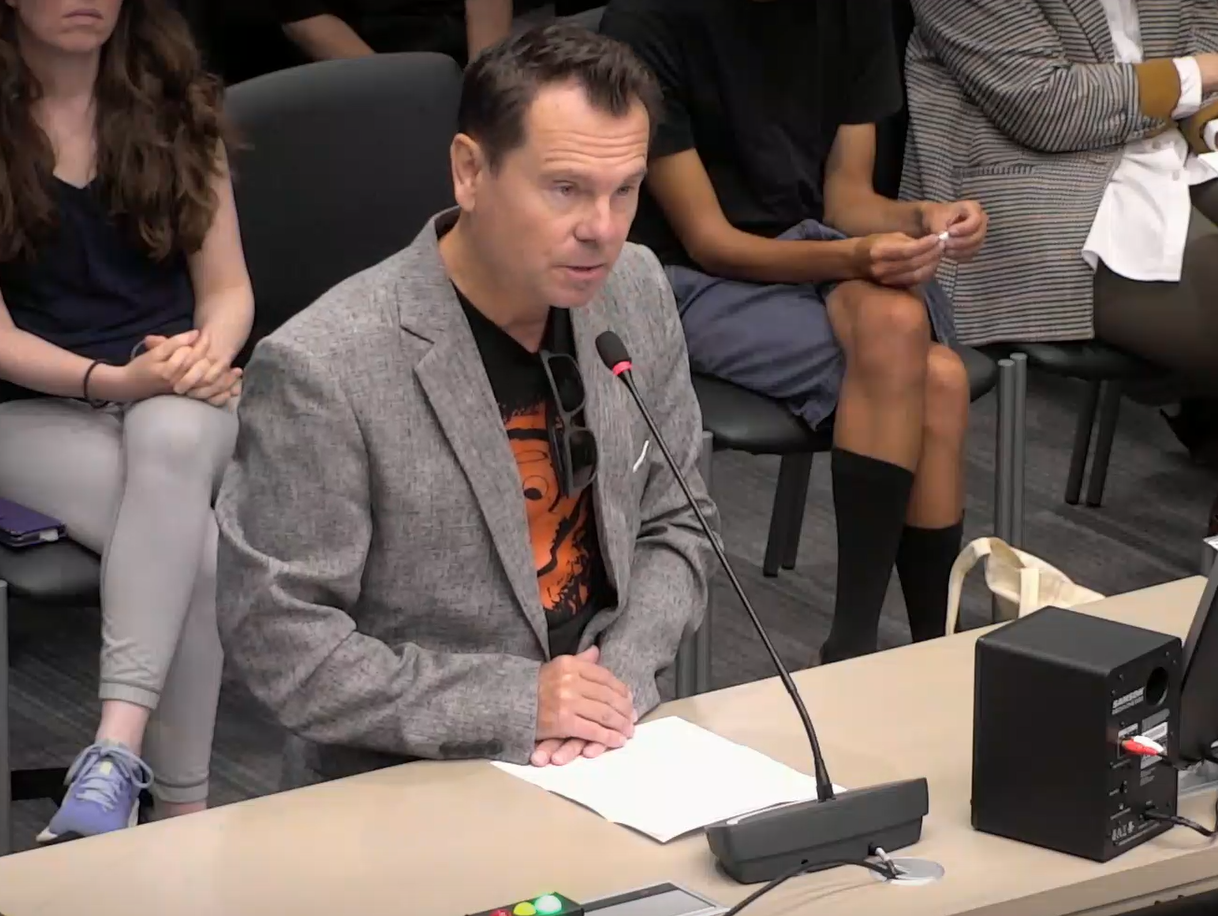
Brent Kinnaird, the vice president of festival operations, spoke first. Holding back tears, Kinnard spoke about many of the ways that SOM contributes to the community.
“Sound of Music is not merely an expense line for the city,” Kinnaird said. “It’s an investment. In people. In business. In community. For anyone to suggest that you can simply replace what we have built is offensive and disrespectful to our team.”
Kinnaird said that SOM has grown their active database of volunteers from 900 to 1500 people since 2019. Over 6000 hours of volunteer time related to the festival are logged and tracked each year.
Kinnaird also said that SOM has relationships with more than 40 local businesses, who “actively participate in working with us around the festival.”
“Our sponsors are entities and brands that employ local residents in this city,” Kinnaird said.
Kinnaird then turned his focus to the arts.
“In 2025 alone, more than 50 artists performed on our stages, a 100% Canadian lineup,” Kinnaird said. “In the last ten years, we have showcased on our stage more than 400 bands, dozens of them from Burlington alone. Providing a spotlight for local and emerging artists has always been at our core. We continued to do this during COVID, when most other events paused.”
Kinnaird also said that SOM had an economic impact of $12.1 million in 2022, according to the Ontario Tourism Regional Economic Impact Model (TRIM).
He said that one-third of those who typically attend the festival are considered a “tourism visitor,” travelling 40-plus kilometres to attend and visit this city. These data came from a 2022 economic impact study from Enigma Research, which included more than 600 survey respondents on-site during the festival that year.
“Taxes supported by Sound of Music in 2022 were also estimated at $5.2 million, generated by festival-related spending, suppliers, and other participants,” Kinnaird said. “$600,000 of this was municipal.”
Kinnaird said that live music generates over $10 billion in GDP, sustains more than 101,000 jobs and returns $3.73 billion annually in government tax revenues.
“Cities are acting on this evidence by investing purposefully in their live music ecosystem to attract visitors, retain talent, and strengthen community identity,” Kinnaird said. “Burlington, with the Sound of Music festival as its summer anchor, has every reason to continue to build on its own strong foundation and leverage this example.”
Kinnaird said that the staff report that the agenda item is based on focuses too much on “Arrears, loans, and support concentration,” but does not factor in the “outputs that we have provided and the overwhelming return on investment.”
Kinnaird said that the financial challenges that SOM is experiencing are not unique, but industry-wide.
Kinnaird ended his delegation with a plea to the city.
“Today, I’m respectfully asking you on behalf of my team to stick with a proven brand,” Kinnaird said. “And be assured, we aren’t just putting on a music festival. We are building community, and we have contributed immensely to the prosperity and the identity of Burlington.”
The proposal from SOM is for the city to forgive an outstanding loan of $225,000 and $20,000 in arrears, provide a “one-time emergency grant of $200,000 to cover unpaid vendor costs,” and approve an increase in annual municipal funding from $150,000 to $350,000.
That would total $750,000 to support one year of the festival.
Mayor Marianne Meed Ward asked Kinnaird about the feasibility of having a free festival for less than that amount.
“We have known in recent times, especially post-pandemic, that sustaining the same model we have is a very big challenge,” Kinnaird said. “So as we go forward, we need to consider how we can tweak and adjust what we do. And the plan that we have put forward has considered those impacts, looked at those logistics, and talked about how the numbers would shake out. Do we move from four days to three? Do we eliminate one of our stages for a year or two until we can get ourselves on a solid footing? I think that the message from our team is we are willing, we are ready, and we are able to bring the bench strength and the expertise we have together to make the necessary adjustments to get ourselves on a sustainable path.”
“Can we do it? Yes. Are we in a painful period right now? Absolutely. But we are not burying our heads in the sand,” Kinnaird continued. “We are not wishing this to go away. We don’t want to keep things the same. We want to change and adapt, and we have all of the pieces. We just need to get the financial stability and the financial house in order.”
Meed Ward asked again if Kinnaird thought it would be possible for the festival to go on solely with the $150,000 that the city usually provides.
Kinnaird said that it would be an “incredible challenge” to do so. He said that the cost of the event in a free model is “well in excess of a million dollars.” However, if the contribution was $150,000 net, “that’s a very different conversation.”
Lisa Kearns, Ward 2 councillor, asked if it was time to step away from a free festival and move to a paid model.
In SOM’s proposal, they mention the idea of a $5 charge per person or $20 for three people.
“I think the short answer is yes,” Kinnaird said. “We need to consider this.”
Kinnaird said that he has had many conversations with people from Burlington Ribfest about how they moved to a paid model.
He said that there are hurdles to overcome with a paid model as well, including community sentiment and added costs.
“It [a paid model] means we would have to completely fence the perimeter of the venue,” Kinnaird said. “So there are some added costs in infrastructure. There are some added costs around security, and from a fire marshal perspective, it would also limit our capacity. So, fewer members of the community would be able to attend the event.”
Kinnaird also said that fencing the park would likely result in approximately half the attendance they would see from a free event.
Kinnaird said that it would be “virtually impossible” for any given entity to replicate what SOM provides if they started from scratch today, unless a large corporate entity like LiveNation were to invest. However, Kinnaird noted, leaning on his experience in the music industry, it would not be something they would even consider due to a lack of profit.
Rory Nisan, Ward 3 councillor, asked what SOM would need from the city to keep the festival free.
Kinnaird said that if the city raised their annual funding to $350,000, it would “in all likelihood be able to maintain the festival on a free basis.”
Operational and logistical costs within the music industry have risen, including for infrastructure and equipment, as well as artist fees, all of which have impacted SOM.
Kinnaird said that SOM has four main streams of revenue: sponsorships, grant funding, vendor fees, and beverage sales in their Beer Garden.
“People are drinking less, so the revenues from the Beer Garden are an increasing challenge,” Kinnaird explained.
Another challenge has been a greater level of competition for government grants and sponsorships than in years before.
“So when you look at our revenue streams, each of them poses more and more of a crunch each and every year,” Kinnaird said.
Should the festival continue, Kinnaird suggested that they will most likely continue to have a 100% Canadian lineup.
“A piece of the motivation for that is also very business motivated because the reality is, with the exchange rates, bringing U.S. talent here is more expensive,” Kinnaird said. “It also adds to our operating expenses because there’s a demand for us to cover some travel costs and accommodation. It’s very strategic in the sense that we’re not just simply holding up a Canadian flag and saying ‘Rah rah, go Canada.’”
Kinnaird said that the response to the all-Canadian 2025 lineup was overwhelmingly positive.
Dave Shepherd, chair of the SOM Board of Directors, delegated next.
Shepherd indicated that the city requested a “forward-looking business plan for 2026, including a best-case proposal outlining our vision strategy and associated financials.”
SOM submitted this report, and city staff, in turn, drafted an analysis report of the 2025 SOM festival. Shepherd said that they were not advised of this report and were not given adequate time to review it.
“We anticipated questions,” Shepherd said. “We expected engagement. The city’s request stated, ‘This information will help us better understand your priorities and determine how the city can best support your efforts moving forward.’ At no point were we advised that our continued existence as the organizing body of the festival might hinge on a single unreviewed report with staff.”
Shepherd said that the city never followed up on the business plan SOM submitted.
“All we are asking for is a fair and open dialogue,” Shepherd said. “Let’s have a conversation. Let’s meet face to face. Let’s bring the facts to the table and work like the professionals that we all are. You have my phone number. All you have to do is pick up the phone.”
Shepherd clarified that the proposal to the city in the business plan is the SOM’s “best-case” scenario and that they would be willing to consider other terms of agreements if given the chance.
Shepherd also said that if the city were to reject the proposal and offer the annual $150,000 of funding to other parties interested in organizing a free music festival in Spencer Smith Park, SOM would consider applying as well.
Meed Ward asked Shepherd how the group plans to pay the outstanding $20,000 that they owe to vendors.
Shepherd said that with a paid model, paying the debt would be possible.
SOM would need to present the city with a plan to pay these debts in order to apply for the aforementioned $150,000.
When the item came up on the agenda, Jacqueline Johnson, executive director of community relations and engagement for the city, gave some opening remarks.
“I just want to begin by acknowledging the long history and the community pride that has been tied to the Sound of Music festival here in Burlington,” Johnson said. “It has been an important part of the identity, as you can see through this morning’s delegations.”
“The recommendation before council isn’t about ending music festivals in Burlington,” Johnson continued. “It’s about ensuring our cultural investments are transparent, sustainable, equitable, and accountable. While the city has provided extensive support, the organization continues to face some hardships and financial challenges, and hasn’t met some key conditions in the agreements. The approach proposed allows us to continue supporting arts and culture across the city and explore new opportunities for music at Spencer Smith Park in a way that’s responsible and sustainable for the long term.”
Staff, Johnson noted, have been in ongoing discussions with the Sound of Music board for several months.
“We’ve helped review some business plans, provide feedback, and extended some timelines,” Johnson said. “We have offered some additional opportunities for clarification, so the submission before council represents their formal and most recent request approved by the board. So it was appropriate for staff to assess that request on its own merits and take it at face value. And we do rely on the organization to represent the needs as accurately as possible.”
Johnson also said that a further conversation with SOM would change any of the recommendations that staff have made to council.
After voting on several amendments to the motion, council offered comments on it before voting.
Meed Ward spoke first.
“I completely support a waterfront music festival,” Meed Ward said. “As you know, I support it being free when we’re using tax dollars. That’s partly related to making sure everyone can enjoy it and that cost does not become any kind of a barrier to anyone fully participating in the festival, so I believe it’s possible.”
Meed Ward also said that providing SOM with $750,000 for this year’s festival was a “non-starter from the get-go.”
Nisan offered his comments next.
“It’s evident that the current operation and organization are in a real bind,” Nisan said. “We could really see the difference between May of this year and our delegations today. My vote is for a free festival, and I will add that I personally will support further funding above $150,000, which is roughly 75 cents per resident, to make this festival a reality next year. Where we’ve gotten today is giving the current Sound of Music incorporation an opportunity to continue to operate the festival and to get involved, but also giving us an opportunity to look elsewhere, so we can make the best decision for everyone.”
Kearns acknowledged the unique nature of SOM in the context of Burlington.
“Many barriers are broken down at the Sound of Music, physical, mental, economic, etc.,” Kearns said. “It’s a very approachable event with something for everyone, and I hope that if it’s not them, then [someone else] keeps those values at the forefront. I’m not interested in a diluted festival just for the sake of having a festival. We have something really special here. And if it takes the funding, then it takes the funding.”
In his comments, Paul Sharman, Ward 5 councillor, reiterated the city’s commitment to holding a music festival at Spencer Smith Park.
“The thing that I think is important here is that we’re going to keep on doing it, that’s our commitment,” Sharman said. “We’ve got new people coming into the picture, and if they can do it free, they’ll do it free. If they can’t, we’ll have to have a conversation. That’s either going to mean increasing our funding, or it’s going to mean finding another way to make money with it, and those are the choices ahead of us.”
Kelvin Galbraith, Ward 1 councillor, spoke about the challenges still ahead in his comments.
“I do have my doubts about our ability to run this as a free event moving forward,” Galbraith said. “I think times have changed in the economy, and I’m happy to see that our heavy drinkers have been replaced by health-conscious fitness people, but that’s not going to support it going forward. We need to find other revenue sources.”
Council then voted to decline SOM’s current 2026 funding request and invite SOM to participate in the request for expressions of interest.
They also approved the reallocation of $150,000, originally designated for Sound of Music, to the Community Investment Fund, which is earmarked for a future music festival at Spencer Smith Park.
Council also directed staff to draft a report “on exploration of potential opportunities for a different form of music festival and/or a different operator of a music festival at Spencer Smith Park, following a call for expressions of interest from potential event organizers.”
The motion passed unanimously and will now move to the Regular Meeting of Council on October 14.