By Emily R. Zarevich, Local Journalism Initiative Reporter
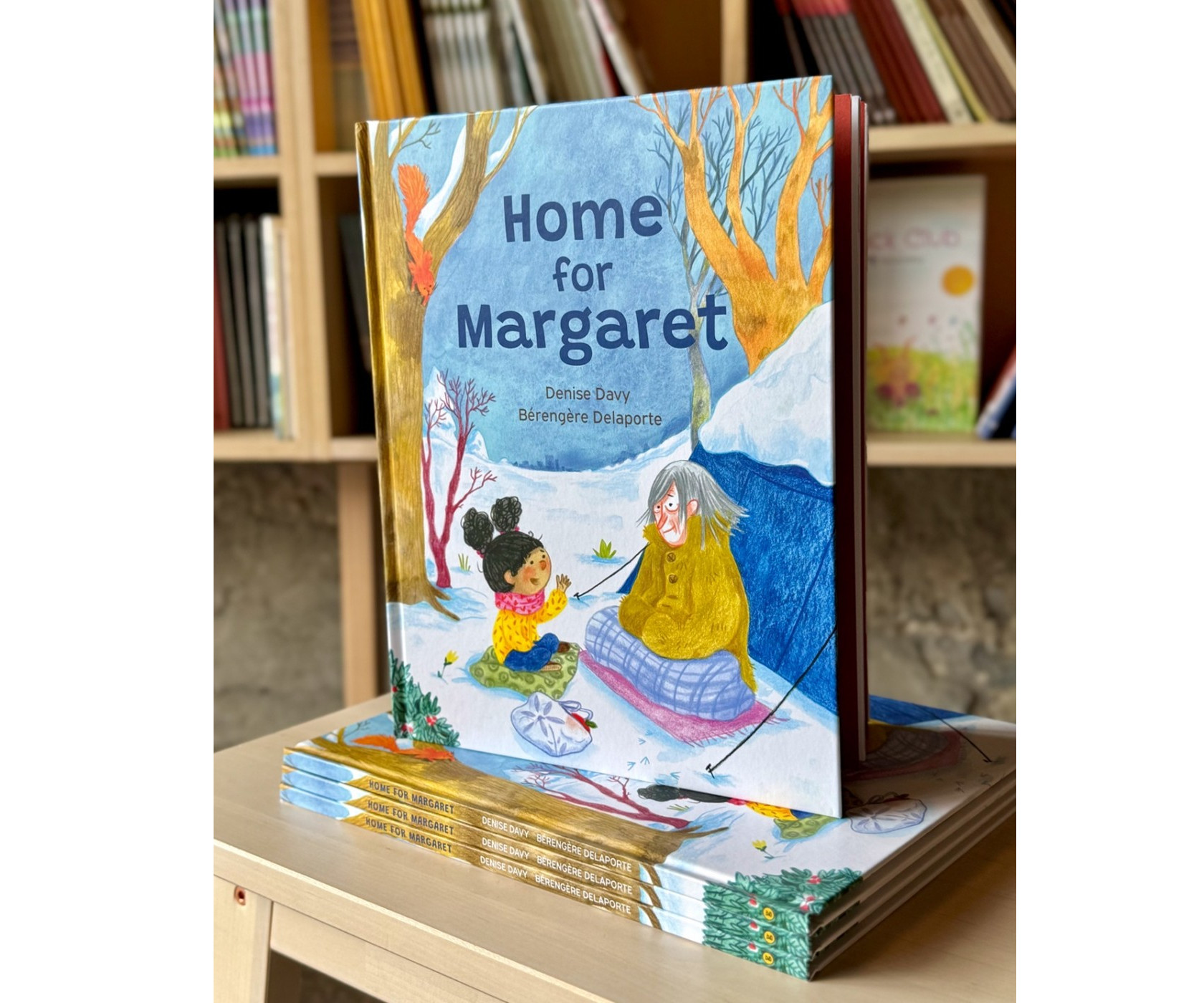
On October 8, 2025, Groundwood Books is set to publish Home for Margaret, a children’s book by Burlington-based, award-winning reporter Denise Davy, aimed at readers aged 3 to 6. A bold venture away from her traditional journalism, this is Davy’s first-ever children’s book. Illustrated by the immensely talented Bérengère Delaporte, Home for Margaret tackles the responsibility to care for the less fortunate from the point of view of a kindly youngster named Emma, a child protagonist who represents every kid in a place of privilege learning about homelessness for the first time.
Back in 2021, James Street North Books published Davy’s Her Name Was Margaret: Life and Death on the Streets. Davy introduced readers to Margaret Jacobson, a real-life Hamilton-based individual who, throughout a long lifetime, made the rounds of psychiatric institutions, homeless shelters, and dark alleyways with corners to huddle in. Davy translated Jacobson’s life story into print and started a necessary conversation about how vulnerable people are being treated in society versus how they should be treated. Davy’s goal in researching and writing Her Name Was Margaret was to humanize homelessness in the eyes of her adult audience. Now, through Home for Margaret, Davy wants to start that very same conversation with kids and teach them from a young age that the people they see out on the streets, exposed to the elements, are, in fact, people.
Home for Margaret’s Emma is a bright, clever, and content girl being raised by a social worker mother. They’re close to each other and make a happy family unit. On a mild, calm winter day, Emma and her mother go for a hike together in Cherry Hill Forest. Pure white snow blankets the ground, and the innocent Emma sees the powdery terrain as her personal playground. She makes snow angels and doesn’t have a care in the world. But then she spots something strange and blue among the trees. She investigates. The blue, as it turns out, belongs to a tent. Dwelling inside of it is a shy, elderly, and withdrawn woman with nose and cheeks reddened by the freezing cold.
She approaches the woman to say hello and introduce herself. Though it takes a couple of tries, Emma does get a reply.
“I’m Margaret,” she says in a low, raspy voice.
Emma’s mother arrives on the scene, but surprisingly enough, doesn’t reprimand Emma for talking to a stranger or whisk her away in fear of the outcast woman. Instead, Emma’s mother shows genuine concern for Margaret’s endangered situation. Emma and her mother are wrapped up warm and snug in their nice winter clothes. Margaret’s worn-out, bulky, tattered coat looks like it won’t see her through the winter. Margaret has no smile to offer to her visitors. She looks exhausted and uncomfortable.
“I hope we aren’t bothering you,” says Mom.
Margaret, disinclined to socialize, crawls back into her tent. Back in their own cozy home, filled with furniture, throw cushions, pictures, and other objects that suggest middle-class comfort, Emma’s mother tells her worried and confused daughter that Margaret does not have a home to live in and that she is not at fault for her circumstances. This launches a campaign between mother and daughter to assist Margaret in any way they can, not just with finding suitable housing, but with having enough food and warm clothes to make it through the winter.

Home for Margaret’s Emma is young and inexperienced, but she is perceptive and good-hearted. Children who are just starting school will learn through her and Margaret’s budding friendship that there is a hidden, isolated population in the world that needs compassion, understanding, and help instead of judgment and scorn. The realization may scare kids at first and make them feel sad, but it can also spur them into action in small, achievable ways. Emma is a child and doesn’t have much to give Margaret in terms of material possessions or wealth, but she runs upstairs and empties her piggy bank anyway to contribute to a much-needed food and clothing parcel that she and her mother put together.
Reading a book like Home for Margaret will also help young readers develop empathy at a young age. Some protective parents prefer to shield their children from the hardships of the world, but Emma’s mother adopts a different attitude altogether. She doesn’t shy away from explaining to her precocious daughter why Margaret is living in a tent instead of a house. As a good role model, she instructs Emma to be empathetic by setting an example.
“Some people have lost their jobs. Some people have health problems. No one chooses to be homeless,” says Emma’s mom.
Delaporte shines as an illustrator through her attention to detail. Special mention must be made especially for the bristles of Margaret’s dull, mustard-yellow coat, which is clearly falling apart. Emma’s own winter coat is lemon-yellow and looks brand new, demonstrating that she is from a stable household with a provider. Delaporte’s style, in general, is elegant and crisp. She designs the characters with feeling and adds a realistic blush to their cheeks. Like all of us, the characters feel and yearn for the warmth of a home.
Denise Davy will be holding a book launch for Home for Margaret at A Different Drummer Books on October 25 from 1:00 p.m.–3:00 p.m. The event will be an opportunity for parents to not only obtain a copy of the book to read with their kids, but allow them to ask questions about homelessness as well. Davy has years of expert knowledge to share.
Davy is also scheduled to give a talk about Home for Margaret and its place in the children’s book canon at the First Unitarian Church in Hamilton on Sunday, November 9, at 10:30 a.m.
Anyone who wishes to contribute to Davy’s campaign to support those experiencing homelessness in Canada can donate to Davy’s Purses for Margaret, which provides essential hygiene products to women currently living in precarious situations.
Update notice: the book launch has been rescheduled to Oct. 25 at A Different Drummer Books.