By Kezia Royer-Burkett, Local Journalism Initiative Reporter
A recent survey conducted by Grandmother’s Voice, a grassroots Indigenous-led organization in Halton, has revealed a strong call for more culturally grounded, Indigenous-focused services and healing spaces in the region. The survey engaged more than 125 service providers and community members, reflecting deep personal commitment and appreciation for the experiences and teachings Grandmother’s Voice has shared so far.
At the heart of Grandmother’s Voice is the belief that Indigenous healing is for everyone.
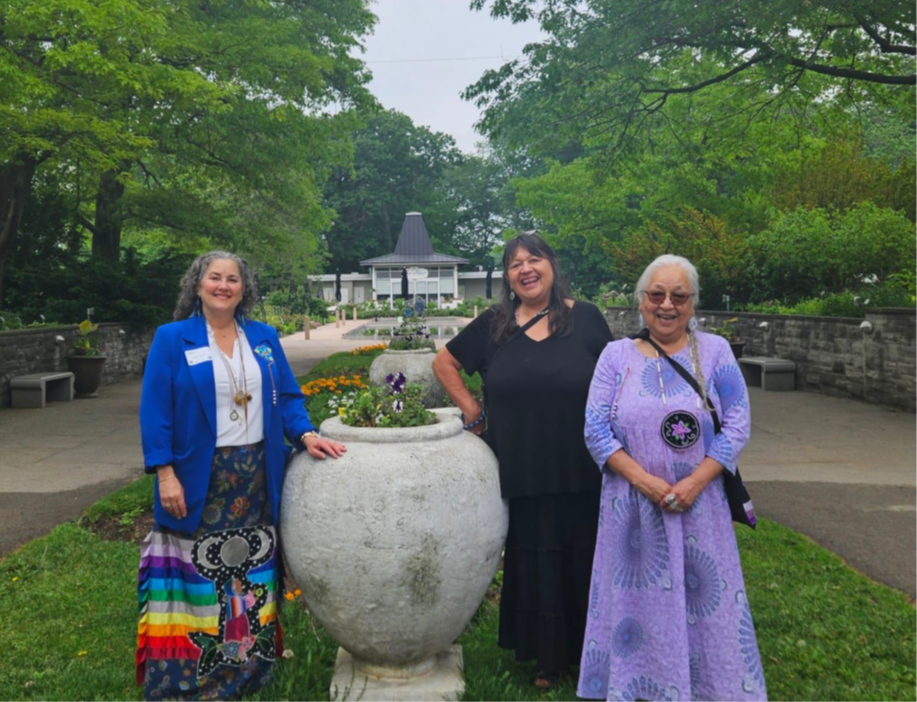
“Elders teach us that we’ve all been colonized and we all carry historical trauma,” said Jody Harbour, co-founder of Grandmother’s Voice. “We’re not looking for allies or settlers to manage our resources — we’re asking to be allowed to lead and to share our knowledge.”
The survey results are being analyzed with Dr. Gabrielle deVeber, a senior scientist in pediatric health at the University of Toronto and a volunteer with Grandmother’s Voice. The work aims to identify Indigenous people living in the region, understand their needs, and assess what services are available — or missing.
“We needed data to apply for funding, to prove that Indigenous people live here and are being underserved,” Harbour said. “Indigenous people just want a place to gather, to commune, and share our gifts.”
The organization is using the findings as the foundation for long-term community transformation. In January, Grandmother’s Voice will launch a community of practice — a regular forum for service providers and community partners to learn from Indigenous teachings and share knowledge in support of Indigenous families. “This is how you create belonging in a community that never had it,” Harbour said.
That sense of belonging is deeply personal for Harbour, who introduces herself through her lineage. “My name is Jody, and my great-grandmother was of the Cayuga Nation from Six Nations of the Grand River Territory,” she said. “Indigenous people introduce themselves by including the land they’re from. Our identity is connected to the land, and that’s why land acknowledgments matter. We all belong to the land and have a homeland.”
Harbour shared that her great-grandmother’s tragic death — officially ruled a suicide after she was poisoned by her husband — became a spiritual catalyst for the founding of Grandmother’s Voice. “She would come and communicate with me. I started a blog in 2008 called My Grandmother’s Voice. It’s always been about amplifying the voices of the matriarchs.”
Those voices are now part of a growing movement in Halton. Grandmother’s Voice has been working with organizations like the Reach Out Centre for Kids (ROCK) and is planning a community walk on September 30, Truth and Reconciliation Day, to honour children lost to residential schools. On October 3, they will unveil the “Living Monument” campaign at the Oakville Museum to memorialize Missing and Murdered Indigenous Women and Girls, including naming a garden in their honour.
This September, the group is also launching “Remember the Children,” a social media campaign highlighting all 139 residential schools that once operated in Canada. “It’s about reminding people of the lived experiences of Indigenous people in this country — every day, one school, one story,” said Harbour.
The ultimate goal for Grandmother’s Voice is to establish a dedicated Indigenous Knowledge Centre for Wellness and Culture, a space for land-based healing, teachings, ceremonies, and cultural connection.
“This is a collective vision. We can’t make it all about powwows. We are past that,” Harbour said. “This is guided by Indigenous Elders who lead the sustainable programming Grandmother’s Voice provides. We know this isn’t something we can do alone. We need our community to come together. That is true healing and reconciliation.”
The organization is committed to supporting the development and accreditation of Dennis Windego’s Indigenous Wisdom for Trauma Recovery – Land-Based Focusing Oriented Therapy Program, which Harbour describes as “the foundation of the centre’s vision.” She added, “His work is international, and he chose our urban community to work with. This is an honour, and Grandmother’s Voice is committed to expanding Dennis’ program for the wellness of all people and his legacy.”
Harbour’s message remains clear: “It’s been hard work, and it doesn’t have to be hard anymore. It’s time to walk together.”For updates on Grandmother’s Voice events, teachings, and the upcoming community of practice, visit grandmothersvoice.com or follow them on social media.