By Jack Brittle, Local Journalism Initiative Reporter
On July 15, Burlington City Council approved the 2026 Financial Forecast, the first step in creating next year’s city budget.
The forecast is meant to highlight areas of interest and concern that council and staff can focus on in the upcoming budget review process.
“This report provides Council with an overview of the known and estimated financial pressures impacting the City,” read the forecast. “It outlines the costs to maintain current service levels and recommends investments in key service areas to achieve Council’s strategic goals.”
The summary also outlined what the investments in the forecast will enable the city to do. These objectives include: “Sustain and enhance essential services for a growing community, improve service delivery, and secure funding for both current and future infrastructure requirements.”
Ward 5 Councillor and Deputy Mayor for Strategy and Budgets Paul Sharman spoke about the need to keep money in reserve for infrastructure.
“A change in policy from the province [in 2015, under the Infrastructure for Jobs and Prosperity Act] requires every municipality to put away money to keep infrastructure in a state of good repair,” Sharman said. “This means that an automatic increase is added to property taxes at a rate of 2% per year (this year, or more in future years), in addition to this year’s inflation of 2%.”
The report also states that the budget will be subject to “rigorous internal review and prioritization by City staff, multiple opportunities for public engagement and feedback, and a formal opportunity for Council to bring forward motions to amend the Proposed Budget.”
As with 2025’s budget, 2026’s will abide by the city’s core principles of “Affordability, Livability, Sustainability, and Transparency.”
Council has directed staff to prepare a proposed budget with a total tax increase of 4.5%. This increase includes portions from the City of Burlington, Halton Region, and the boards of education. The city’s increase will total less than 2%.
The “Key Findings” in the 2026 Financial Forecast expand on the need for this increase.
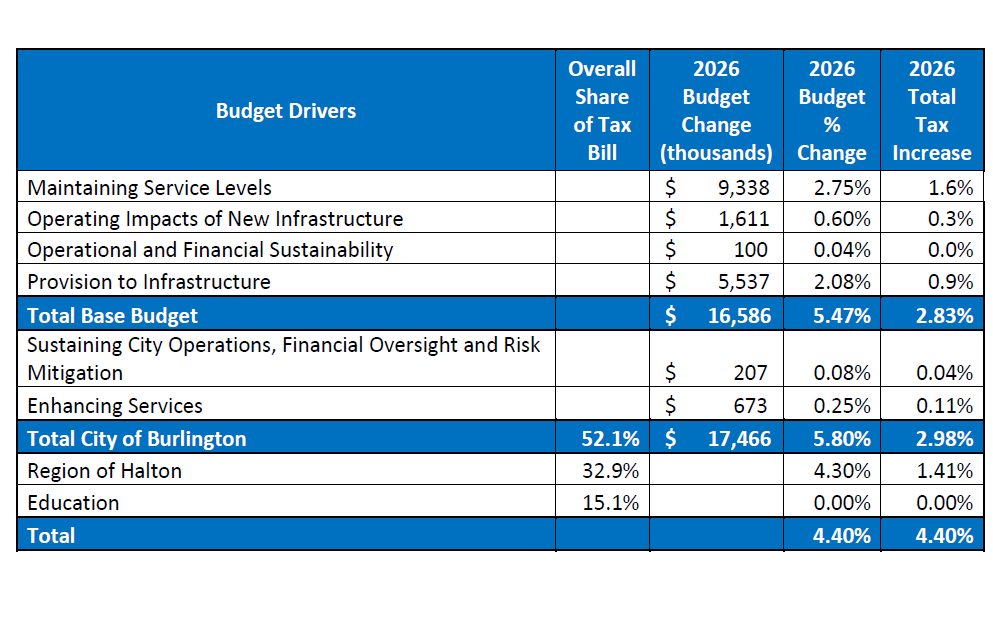
“Based on the investments in current and expanded service delivery included within this report, the City would require a budget increase of 5.80%,” read the report. “Assuming a Region of Halton increase of 4.3% and no change for Education, the overall tax increase is forecasted to be 4.40%, equivalent to $42.71 per $100,000 of residential current value assessment (CVA). Burlington’s portion of the overall increase would be 2.98%.”
Sharman said that the city is trying to ease any financial squeeze that’s been caused by tax increases in years past.
“We’re dealing with lower inflation rates, which will help a lot,” Sharman said. “Our goal is to reduce the pressure that’s occurred from tax increases over the last three years.”
To prepare the budget, the city uses a five-year simulation to identify “major budget drivers and expected future tax rate impacts.”
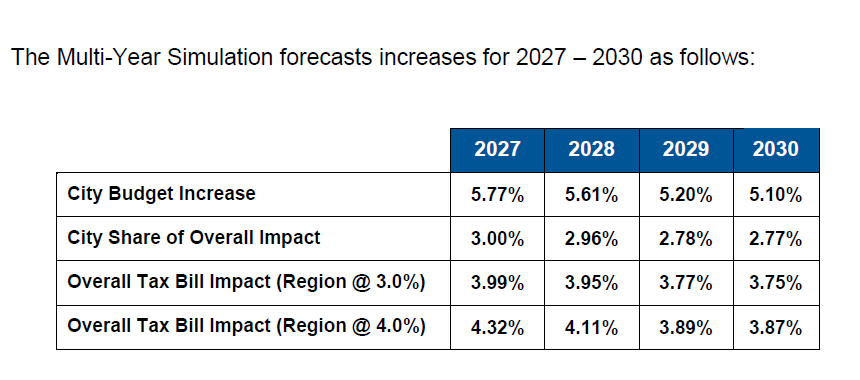
When creating the simulation, the city takes into account contractual obligations, growth projections, infrastructure funding, and financial commitments, among other factors.
Public engagement on the budget will begin on August 25, when the 2026 Budget Survey opens up to the public.
The fifth annual Food for Feedback will also have a booth dedicated to the budget, and several townhalls, including one held via telephone, will be organized throughout the year.
Each town hall will take place in a different ward, but attendees do not have to live in said ward to participate. Residents can also join each consultation session online if they can not make it in person.
Council will approve the 2026 budget on December 2 at a special meeting of council. Go to the Get Involved Burlington website for updates and more information on ways to provide feedback on the budget.