By Kezia Royer-Burkett, Local Journalism Initiative Reporter
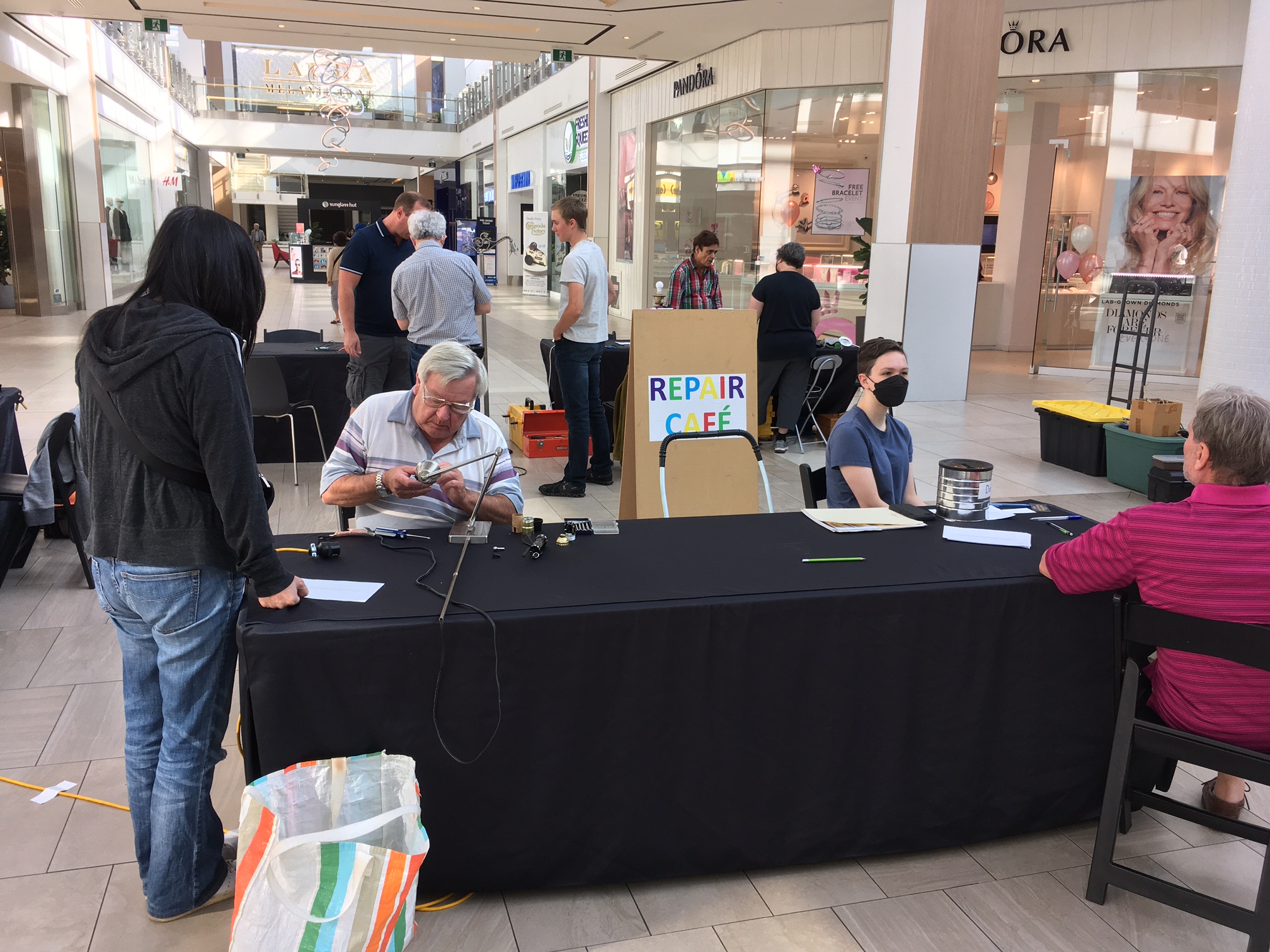
For six years now, the Burlington Repair Café has been quietly making a big impact — one broken toaster, lamp, or toy at a time. On May 24, 2025, the initiative will celebrate its sixth anniversary at Burlington Centre mall between 10 a.m. and 2 p.m., marking a journey that began with just four volunteers and three items. Today, the café boasts a team of 14 volunteers who, once a month, help community members repair an average of 40 household items, diverting them from the landfill and saving them from obsolescence.
The inspiration for the Burlington Repair Café came from halfway around the world. “I discovered the idea of Repair Cafe that started in the Netherlands some 17 years ago,” said founder Lawson Hunter. “Since then, there are about 3,000 Repair Cafés around the world.” He saw an opportunity to bring the same philosophy to Burlington — a belief that everyday items deserve a second chance and that people, given the right tools and guidance, can become part of the solution.
“There were all kinds of repair shops years ago,” Hunter explained. “But now, they’ve all sort of disappeared. So many things break after just a couple of years, and people don’t know what to do with them.” That’s where the Repair Café steps in. Residents are invited to bring in broken household items — small electronics, toys, clocks, lamps, and more — and work alongside volunteers to fix them on the spot. “You don’t need an engineering degree,” Hunter said. “You just need to be handy and want to help the community.”
The Repair Café’s contribution to sustainability is undeniable. With a repair success rate of 65% to 70%, the team has saved more than 1,200 items from ending up in the trash. “We’re fighting against this disposable consumerism,” said Hunter. “Manufacturers don’t want you to fix things. They want you to throw them away so you can buy a new one.” While the team avoids items with circuit boards, since they often require specialized tools and knowledge, they tackle a wide variety of mechanical fixes, from lamps to broken clock arms and small appliances.
“People often say, ‘It just stopped working,’” said Hunter. “So we ask them to be specific when they register — what’s working, what isn’t. That way, we can be better prepared with tools or parts. It makes the process smoother and often more successful.” Most repairs take about 30 minutes, and the model is all about community involvement: no drop-offs, no pickups. Visitors are encouraged to sit, watch, and learn. “It’s not just a fix-it place — it’s a learning space. Even our volunteers learn from each other.”
Community response has been overwhelmingly positive. “We get emails and cards all the time thanking us,” said Hunter. “Even when we can’t fix someone’s item, they often still donate. It really shows how appreciated this service is.” The Repair Café runs entirely on donations, which go toward insurance and replacement parts. “We don’t usually charge for parts, so those contributions mean a lot.”
One of the most memorable moments came when an eight-year-old girl arrived with her favourite toy — an arcade-style claw machine that had stopped working. “Her mom said she was heartbroken,” said Hunter. “So our volunteer handed her a screwdriver and showed her how to open it up. She helped with the repair, and when she pushed the button and it worked, she just floated out of there.” Teaching the community how to fix their household items sparked what is now known as the “Take It Apart Party,” where youth aged 15–25 are invited to learn by disassembling and watching a volunteer reassemble everyday items like lamps and toasters. “One youth is now volunteering with us,” Hunter shared with pride.
Another standout success involved a 1954 toaster brought in without any knobs. “It was beautifully made and had very simple mechanics,” said Hunter. “We were able to fix it because of how it was designed. Compare that to newer appliances, which often contain complex circuit boards designed to be unrepairable. It’s ridiculous that we’re given one- or two-year warranties when things should last longer.”
The Burlington Repair Café has become a model for surrounding communities. There are now similar cafés in Toronto and Milton, and the Burlington team has helped mentor groups in Dundas, Oakville, and Milton. “Every town should have a Repair Café,” Hunter emphasized. “We’re always open to donations, and we encourage everyone to come out — there’ll be refreshments on May 24 as we celebrate our sixth anniversary.”
Interested residents can register for upcoming events via email at burlingtonrepaircafe@cogeco.ca or message the group on Facebook. As Hunter puts it, “It’s a win-win. We keep things out of the landfill, save people money, and build a stronger, more connected community.”