By Jack Brittle, Local Journalism Initiative Reporter
On May 12, Burlington City Council held their monthly Committee of the Whole meeting to discuss various items relevant to the city and its citizens. Blake Hurley, commissioner of legislative services and city solicitor, introduced a final report on the council composition and ward boundary review that has been ongoing since last year.
The report was presented by Jack Ammendolia from Watson and Associates Economists Ltd., who worked on the review for the city. Ammendolia said that the two most popular options amongst residents who completed the city’s ward boundary review survey were consistent with the consultant’s recommendations.
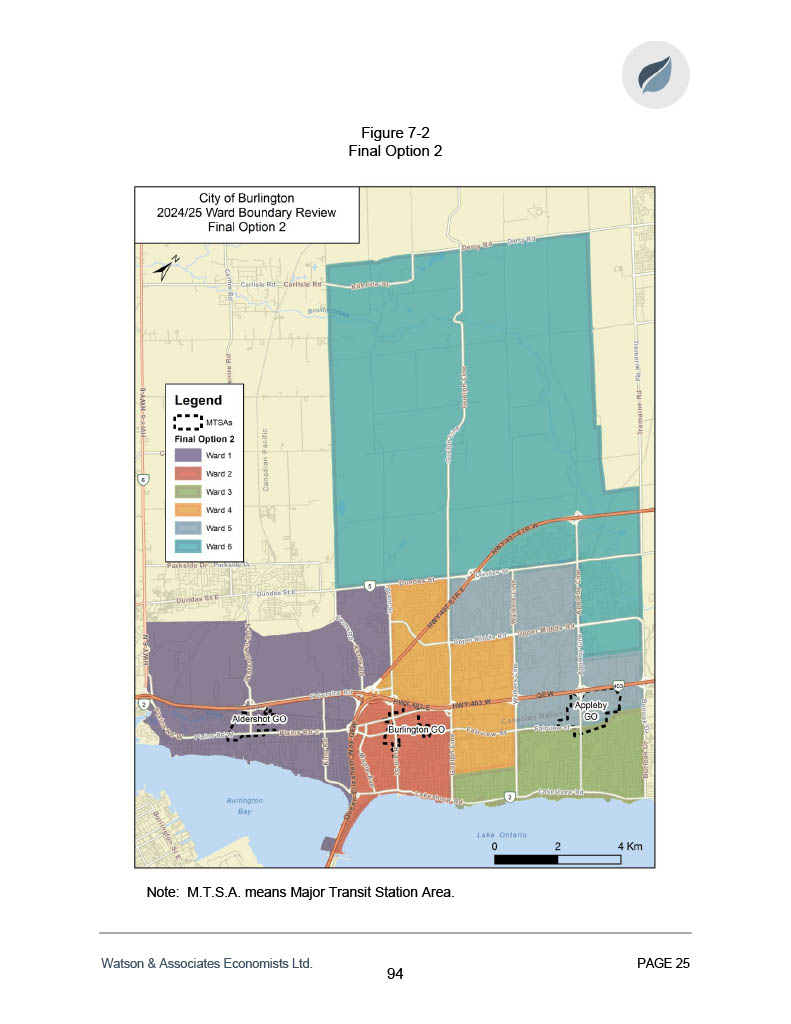
In option 1, the populations in Wards 1 and 6 grow outside of the optimal range in 2025, with Wards 2 and 4 moving into optimal parity. The remaining wards would reach the acceptable ±15% population variance by 2035. In this context, “parity” refers to achieving similar population sizes across wards. The review also considered other key factors, including preserving communities of interest and accounting for both the current population and projected population changes.
“It mixes things up and retains some familiarity in the western and southwestern portion of the city,” Ammendolia said. “But we do see some wards change in the central and eastern part of the city. One notable change is that there would be a larger rural ward as opposed to the rural area now being divided among two wards.”
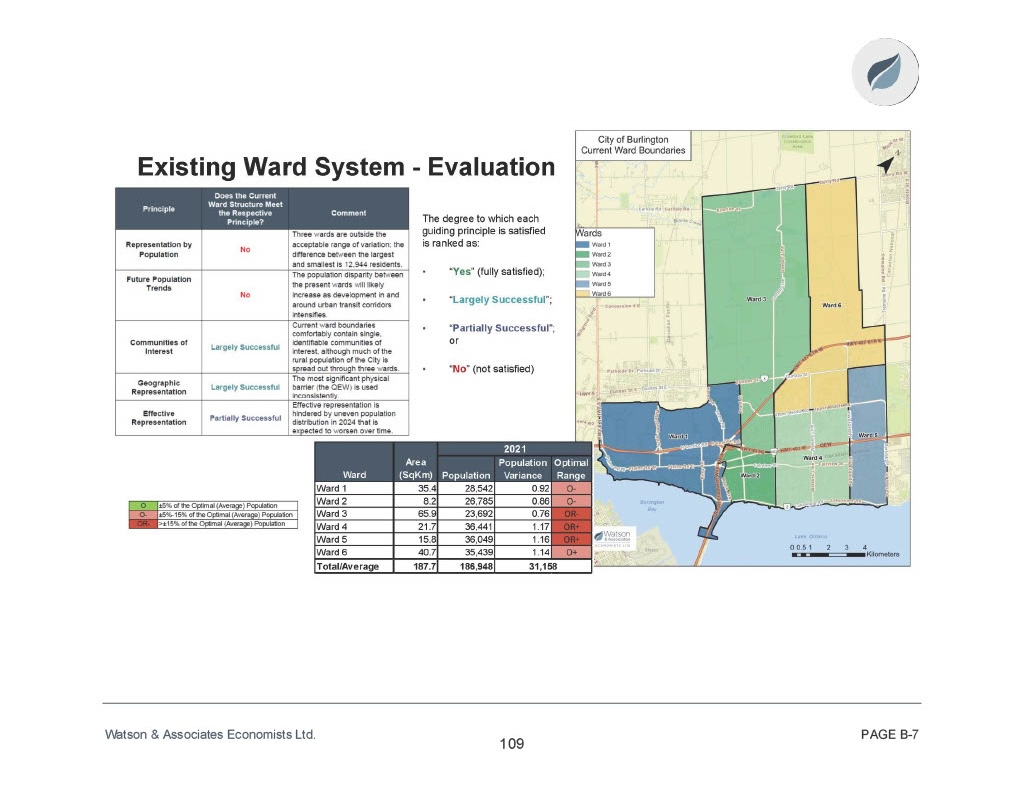
In this option, only Ward 1 is below the acceptable range, by 1 point, and the rest are within the acceptable range, with Ward 2 at the optimal point.
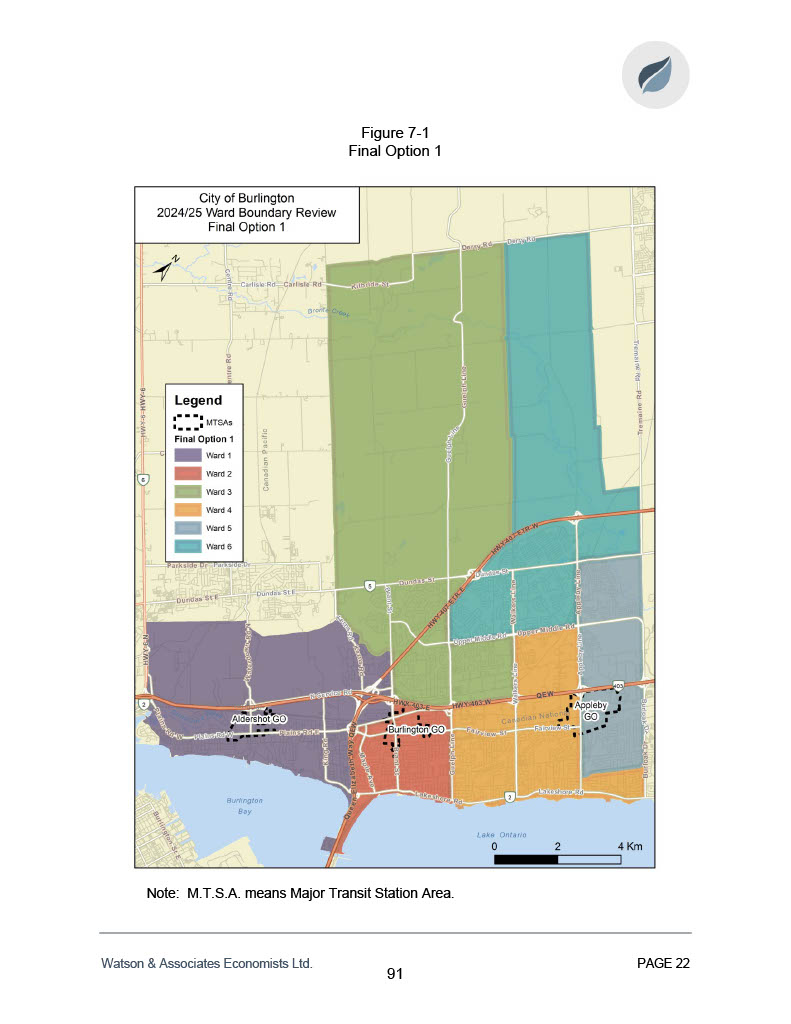
Wards 1–4 would grow into optimal parity by 2035, and 5 and 6 would be within 15%.
Watson and Associates is recommending that the city consider option 1.
“The reason behind that recommendation is really to do with the uncertainty that we’re experiencing right now,” Ammendolia said. “Option two comes into very good parity, but it does rely on some of those population estimates to be carried out.”
Ammendolia said that because of the uncertainty of the higher-density development coming to Burlington, he expects actual population growth to be different from current estimates.
Ammendolia said that council can either choose one of the two final options, one of the preliminary options, propose an amendment to one of the options, or stick with the current ward boundaries.
Rory Nisan, Ward 3 councillor, asked why Watson and Associates’ preferred option still has significant population parity issues in the present, and raised concerns about the uncertain nature of the projections for 2035.
Ammendolia said that trying to balance all of the guiding principles is difficult.
“We recognize that there is not a perfect one amongst the seven options, but we think that they are all viable, defensible, and get Burlington to a place of effective representation,” Ammendolia said. “There’s always going to be a little bit that I think we have to inherently give up. Even with as close to a perfect system as we get.”
Nisan questioned why the first option splits Upper Tyandaga from the rest of the neighbourhood, effectively separating a community of interest between different wards.
Nisan said he doesn’t “see the push and the pull there, when one ward is more than 10,000 [people] than another.”
Ammendolia said that the ward boundary review is about trying to balance the guiding principles and noted that an option with better population parity may not maintain communities of interest as well.
“The difference in population that we’re talking about, we might get perfect in 2025, and then you might have to do this again right after the next election as some of that growth occurs.”
Ammendolia said that in community engagement sessions, perspectives on where Tyandaga begins and ends were mixed, and said, “It’s up to council to give us that feedback on what they consider that community of interest.”
Paul Sharman, Ward 5 councillor, asked how urgent a change to the ward boundaries is, given the relative uncertainty around population growth and new housing developments. Sharman asked if it would be better to leave this decision to the next council.
Ammendolia said that it is up to the council to decide how necessary this change is for the current time.
“We’ve been clear that the existing system is not bad,” Ammendolia said. “With regard to option one, we have tried to really take that into consideration and say, ‘Okay, if we only want to change one or two things, like trying to close that population balance a little bit better and trying to understand a couple of things we heard from some councillors and the public in terms of changing a line,’ I think option one sort of gives you that transitionary change that you can then look at a few years later and say, ‘Do we have to do something more significant?’”
Nisan asked why, in one of the final two options, the rural area of Burlington has significantly less representation than it currently does.
According to Nisan, currently, three councillors and the mayor have jurisdiction over rural parts of the city, although Ammendolia referenced two current rural wards as opposed to three.
“When we consolidated [the rural area] into one ward, we’re able to get a lot better population parity, whereas with two wards, it’s a little bit different,” Ammendolia said. “What I hear around the province, some think that when one councillor represents a largely rural ward, every single issue that comes to the table has that perspective to it. Some think that more councillors representing some portions of rural areas might be better. The problem we’re seeing with that latter approach is that as those rural areas diminish, there’s no rural area in Burlington that is completely self-contained in a ward because the population would be way too low to recognize as a ward.”
Shawna Stolte, Ward 4 councillor, asked what the process would look like were the city not to make any changes right now but wait for the next election cycle.
Hurley said that the council would have to start the review process from the beginning and allocate the appropriate funds for such. The city set aside $225,000 for the current review.
Hurley also noted that the last ward boundary review before this year was 20 years ago.
The city has until the end of this year to change the current ward boundaries, but Hurley said in order to prepare for a potential Ontario Land Tribunal appeal and make sure the new structure is in place for the next election, they would have to start the process of change now.
Stolte said that she has no intention of postponing the decision on the review.
Stolte tabled an amendment to move a section from Lakeshore East of Appleby from Ward 4 to Ward 5, so that the Elizabeth Gardens neighbourhood stays in Ward 5.
Paul Sharman, Ward 5 councillor, said that he would not support the main motion approving final option one if the amendment doesn’t pass.
“I cannot abandon my Ward 5 residents whom I’ve been working with now for 15 years,” Sharman said. “And should I plan to run again, I will want to continue to represent them.”
Ammendolia said that this proposed change would “flip the script” on the population of the two wards, and add 6300 people back from Ward 4 to Ward 5.
“It still meets the guiding principles,” Ammendolia said. “The population is still within our acceptable range, and it still meets the community of interest principle because it’s the existing ward now.”
Ammendolia did caution that if current growth projections are to be believed, this amendment could pose a population parity issue.
Kearns raised her concern about Sharman’s comments and brought up the concept of gerrymandering.
“The commentary provided by the Ward 5 councillor caught my ear around a practice that’s often used in elections that’s frowned upon,” Kearns said. “It’s gerrymandering, and it is adjusting boundaries for the benefit of either the incumbent or someone with a particular tie to a particular area. It’s excluding certain portions of a certain demographic that may not be aligned with a certain candidate’s platforms.”
Sharman responded to the comment.
“If you would care to look at the votes by polling station in the last three or four elections, you would find it would be not even remotely a matter of gerrymandering,” Sharman said. Ammendolia also stressed that councillors were within their rights to request amendments and that it was his job as the consultant to advise council whether any requested amendment is consistent with the guiding principles of the review.
The amendment passed unanimously.
Mayor Marianne Meed Ward spoke to the main motion before taking it to a vote.
“I think this is the right approach for now, a light touch to correct some things,” Meed Ward said. “I also think that it’s a reminder to us that we shouldn’t wait 20 years to look at these things. I think probably, if not once a term, at least every two terms, there should be an automatic review just to check in, in light of the growth that is happening, to make sure that there’s parity.”
The motion was approved unanimously; the approved ward boundary plan (option one) will go before the City of Burlington’s regular council meeting this coming week, on Tues., May 20.